How AI Deep Learning Transforms Business Decision-Making
Understanding Deep Learning: The Foundation of Modern AI
Deep learning, also known as profound education in the context of advanced machine learning, represents one of the most revolutionary approaches to artificial intelligence that enables machines to perceive and comprehend the world in unprecedented ways. This sophisticated subset of machine learning utilizes multilayered neural networks to simulate the complex decision-making power of the human brain, going far beyond traditional computational limits.[1][2][3][4]
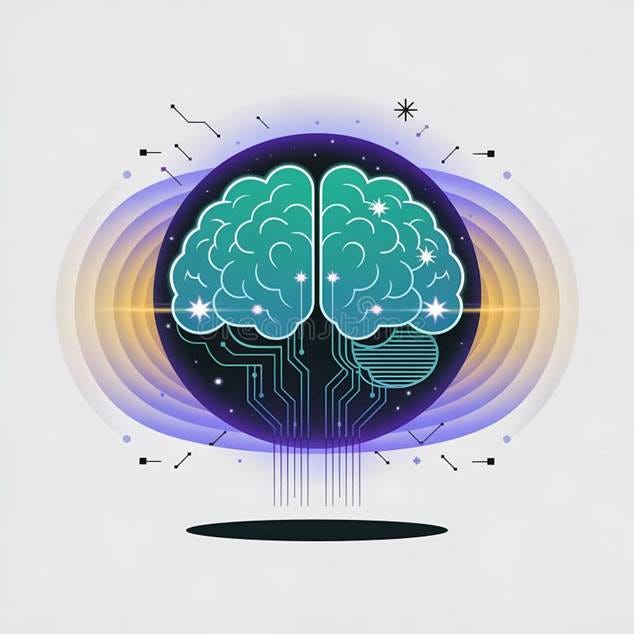
Digital illustration of a stylized brain with neural network circuits symbolizing artificial intelligence and deep learning concepts.
At its core, deep learning employs deep neural networks (DNNs) that consist of multiple layers between input and output layers, creating mathematical models that can identify complex patterns in data. Unlike traditional programming methods, these networks learn and adapt through experience, continuously improving their accuracy and performance over time.[2][5]
The Business Impact of Deep Learning Technologies
Transforming Corporate Operations
Modern enterprises are discovering that deep learning technologies offer transformative capabilities across multiple business functions. Artificial intelligence transformation has become a strategic initiative where businesses adopt and integrate AI into their operations, products, and services to drive innovation, efficiency, and growth.[6][7]
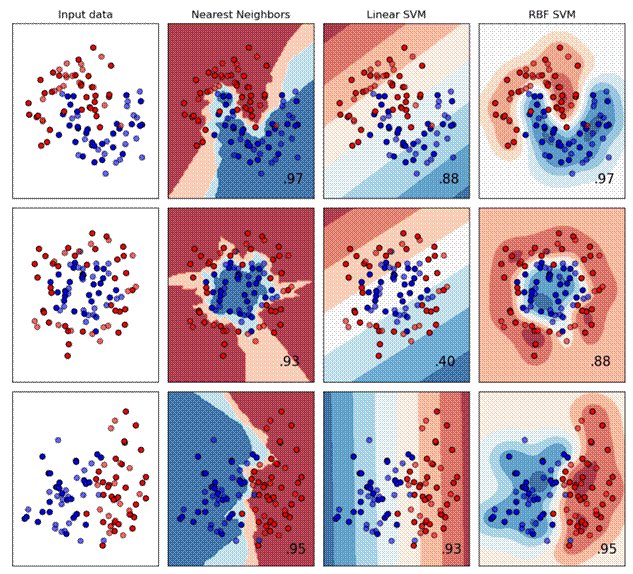
Comparison of classification boundaries and accuracy scores for nearest neighbors, linear SVM, and RBF SVM on three example datasets.
The most successful business transformations leverage AI to reshape entire organizations by:[6]
· Accelerating discovery by automatically mapping interconnected assets and processes across the enterprise
· Delivering deeper analytical insights by processing vast amounts of organizational data
· Testing future-state scenarios through advanced modeling and simulation
· Supporting implementation with personalized change management and real-time progress tracking
Real-World Applications Across Industries
Deep learning methodologies are creating tangible business value across diverse sectors:[8][9]
Financial Services: JPMorgan Chase utilizes neural networks for fraud detection and risk management, analyzing vast volumes of transactions to identify unusual patterns and assess credit risk more accurately.[10][11]
Healthcare: Google Health employs deep learning technology to enhance medical imaging analyses, including identifying signs of diabetic retinopathy and anemia in eye scans.[10]
Retail and E-commerce: Netflix’s recommendation system uses sophisticated machine learning algorithms that analyze viewing history, ratings, and viewing patterns, saving the company an estimated $1 billion per year in customer retention.[12]
Manufacturing: General Electric applies AI-driven predictive maintenance to monitor equipment health and prevent costly downtime by analyzing sensor data to predict potential failures.[9]
Strategic Implementation Framework
Identifying Business Opportunities
The key to successful AI implementation lies in identifying specific areas where deep learning can create the most impact. Organizations should focus on:[13]
Data-Rich Processes: Areas with substantial data volumes that can benefit from pattern recognition and predictive analytics.[14][15]
Repetitive Decision-Making: Processes that require consistent judgment calls based on data analysis.[16]
Customer Experience Enhancement: Opportunities for personalization and improved service delivery.[8]
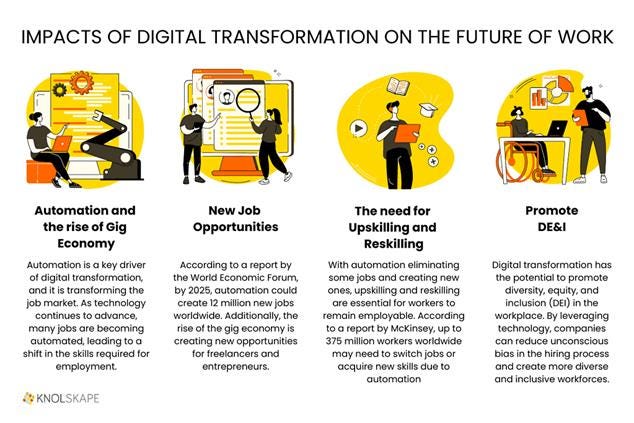
Impacts of digital transformation on the future of work, including automation, new job opportunities, upskilling needs, and promoting diversity, equity, and inclusion.
Building AI Capabilities
Successful integration requires a structured approach:[15]
1. Develop a Clear Vision: Define specific goals and objectives for AI integration, understanding the problems to solve and desired outcomes.
2. Invest in Talent and Training: Build teams with appropriate skills through training existing employees and hiring AI expertise.
3. Start with Pilot Projects: Begin with small-scale implementations to test feasibility and impact before scaling up.
4. Focus on Data Quality: Ensure data accuracy, completeness, and proper management as the foundation for effective AI models.[10]
The Competitive Advantage of AI Adoption
Enhanced Decision-Making Capabilities
Deep learning empowers organizations to make data-driven decisions based on real-time insights rather than intuition or historical precedent. Machine learning algorithms analyze multiple data sources, identifying patterns and trends that inform strategic business decisions while reducing human error and providing clearer understanding of potential outcomes.[14]
Digital illustration of a human brain with neural networks representing artificial intelligence and deep learning concepts.
Predictive Analytics represents a powerful subset of machine learning that helps businesses forecast trends and anticipate changes in customer behavior. By analyzing historical data and market conditions, AI-powered systems offer insights that enable companies to proactively adjust their strategies.[14]
Operational Excellence Through Automation
AI transformation enables businesses to automate administrative tasks, facilitate hyperpersonalized customer experiences, and modernize IT processes. Organizations implementing AI-assisted approaches are significantly accelerating their business transformations while achieving comprehensive transformation intelligence.[6][7]
The technology provides interconnected visibility across organizations, from systems and data assets to workflows and team interactions, helping leaders understand the full scope of change impact before implementation.[6]
Future-Ready Business Strategies
Embracing Continuous Learning
The most forward-thinking organizations recognize that AI transformation represents more than simple process replication with new technologies. Well-crafted AI transformation strategies create entirely new ways of doing business, increase productivity, and facilitate sustainable growth.[7]

Holographic projection of a digital brain highlighting artificial intelligence and neural networks
As artificial intelligence continues to advance, companies that integrate AI into their transformation journey more frequently outperform their competitors. The technology enables businesses to build AI more deeply into operations, transforming how organizations work fundamentally.[7]
Building Scalable AI Architecture
Modern AI implementations focus on creating systems that can scale with business growth, handling increasing amounts of data and complexity. This scalability ensures that AI investments continue providing value as organizations expand and evolve.[17]
Cloud computing adoption effectively addresses computational resource challenges by providing scalable processing power and storage based on immediate needs. This approach helps manage costs efficiently while eliminating the need for substantial initial hardware investments.[10]
Conclusion: The Path Forward
The integration of deep learning and advanced AI methodologies represents a fundamental shift in how businesses operate and compete. Organizations that successfully implement these technologies gain significant advantages in efficiency, customer experience, and strategic decision-making capabilities.

A person holding a smartphone with various glowing artificial intelligence (AI) icons representing different AI technologies and applications relevant to digital business transformation.
The transformation requires thoughtful planning, appropriate talent investment, and a commitment to continuous learning and adaptation. As AI technologies continue advancing, businesses that embrace this profound educational journey will be best positioned to thrive in an increasingly complex and competitive marketplace.
The future belongs to organizations that can harness the power of deep learning not just as a technological tool, but as a strategic catalyst for comprehensive business transformation. By understanding and implementing these advanced methodologies, companies can transcend traditional operational limits and achieve unprecedented levels of performance and innovation.
⁂
1. https://www.simplilearn.com/tutorials/deep-learning-tutorial/deep-learning-algorithm
2. https://en.wikipedia.org/wiki/Deep_learning
3. https://www.ibm.com/think/topics/deep-learning
4. https://aws.amazon.com/what-is/deep-learning/
5. https://www.coursera.org/articles/deep-learning-models
6. https://www.signavio.com/post/ai-in-business-transformation-from-insight-to-impact/
7. https://www.ibm.com/think/topics/ai-transformation
8. https://www.netguru.com/blog/ai-business-applications
9. https://onlinedegrees.sandiego.edu/artificial-intelligence-business/
10. https://appinventiv.com/blog/neural-network-applications-in-business/
12. https://www.chatbase.co/blog/machine-learning-business
13. https://www.uptech.team/blog/ai-implementation
14. https://provenconsult.com/7-benefits-of-using-digital-transformation-machine-learning/
15. https://agilyxgroup.com/the-role-of-ai-and-machine-learning-in-business-transformation/
18. https://www.tekrevol.com/blogs/machine-learning-and-its-applications-in-business-sectors/
19. https://global.fujitsu/en-global/insight/tl-wayfinders-payne-ageofai-20250626
20. https://online.hbs.edu/blog/post/ai-digital-transformation
21. https://www.ibm.com/think/topics/machine-learning-use-cases
22. https://www.weforum.org/stories/2025/01/how-leaders-can-drive-business-transformation/
23. https://www.hyperscience.ai/resource/machine-learning/
24. https://www.oracle.com/ae/artificial-intelligence/machine-learning/what-is-deep-learning/
25. https://www.bain.com/insights/unsticking-your-ai-transformation/
27. https://artificialintelligence.health/artificial-intelligence-methods.html
29. https://moldstud.com/articles/p-how-do-companies-use-neural-networks-developed-by-their-team
30. https://www.ibm.com/think/topics/artificial-intelligence-business-use-cases
31. https://www.ibm.com/think/insights/enterprise-transformation-extreme-productivity-ai
32. https://cloud.google.com/discover/ai-applications
34. https://selecttraining.ae/what-is-neural-network/
35. https://www.mesh-ai.com/blog-posts/machine-learning-in-the-enterprise
36. https://www.tableau.com/data-insights/ai/examples
37. https://mize.tech/blog/how-does-a-neural-network-work-implementation-and-5-examples/
38. https://www.imd.org/blog/digital-transformation/machine-learning-reshaping-business/
39. https://builtin.com/artificial-intelligence/examples-ai-in-industry
40. https://merehead.com/blog/implement-neural-networks-business/