AI Evolution: Where Symbolic Logic Meets Neural Intelligence
The artificial intelligence revolution stands as one of the most profound technological transformations of our era. What makes this evolution particularly fascinating is how diverse computational approaches—from symbolic reasoning systems to machine learning algorithms and artificial neural networks—have converged to create the sophisticated AI landscape we witness today.[1][2][3]
The journey from rule-based expert systems to deep learning architectures represents more than mere technological advancement. It embodies a fundamental shift in how machines process information, learn from data, and solve complex problems that once required human intelligence.[4][5]
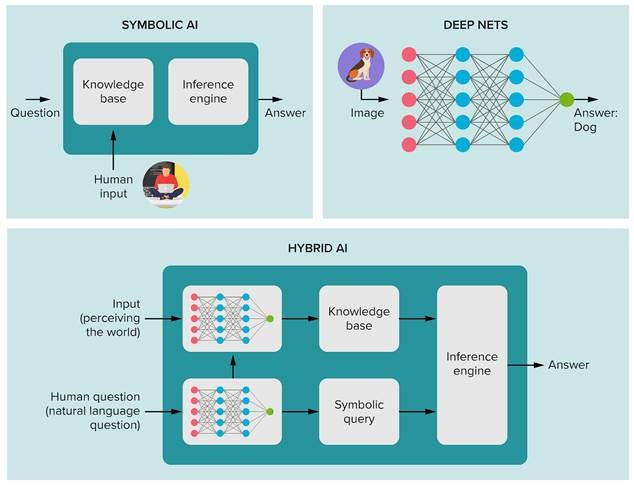
Diagram showing how symbolic AI, deep neural networks, and hybrid AI combine to process inputs and generate answers.
The Foundation: Symbolic Logic and Early AI
The story of artificial intelligence begins with symbolic logic, a computational approach that dominated AI research from the 1950s through the 1980s. Early pioneers like John McCarthy, who coined the term “artificial intelligence” at the 1956 Dartmouth Workshop, envisioned machines that could manipulate symbols and follow logical rules to solve problems.[1][4][5]
Symbolic AI systems worked by representing knowledge as symbols and rules, much like how humans use language and reasoning to understand their world. These early systems demonstrated remarkable capabilities in specialized domains, particularly through expert systems in the 1970s and 1980s that captured human expertise in fields like medical diagnosis and financial analysis.[2][4][1]
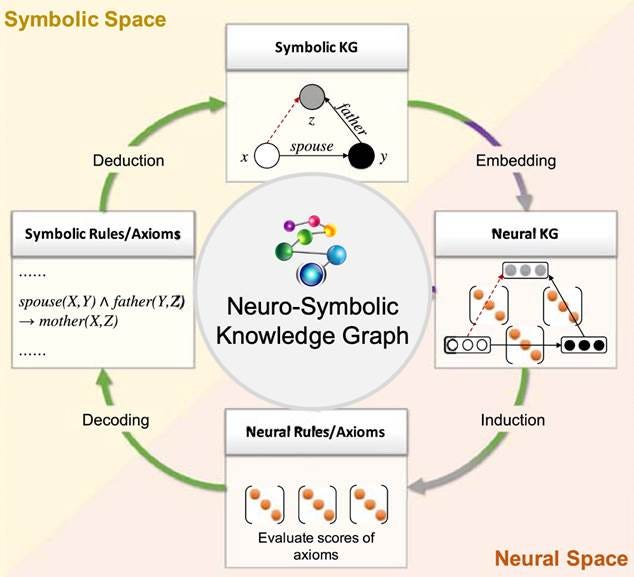
Diagram showing how symbolic logic and neural networks integrate in neuro-symbolic knowledge graphs to advance AI.
The strength of symbolic AI lay in its transparency and interpretability. When these systems made decisions, they could explain their reasoning in terms that humans could understand and verify. This approach proved particularly valuable in applications where understanding the decision-making process was crucial.[2]
Neural Networks: Mimicking the Brain
Parallel to symbolic AI development, researchers pursued a fundamentally different approach inspired by the human brain. The foundations of artificial neural networks trace back to 1943, when Warren McCulloch and Walter Pitts created the first mathematical model of a neural network.[3][6]
Frank Rosenblatt’s development of the perceptron in 1958 marked a significant milestone, demonstrating that artificial networks could learn from data and classify information. However, the field experienced setbacks when Marvin Minsky and Seymour Papert highlighted the limitations of simple perceptrons in 1969, leading to reduced interest in neural network research.[7][6][3]
The revival came in the 1980s with the rediscovery of backpropagation algorithms, which enabled the training of multi-layer networks. This breakthrough laid the groundwork for the deep learning revolution that would transform AI decades later.[6][3][7]
Machine Learning: The Data-Driven Revolution
The 1990s witnessed a paradigm shift toward machine learning and data-driven approaches. This transformation was fueled by increased availability of digital data and advances in computing power, enabling systems to learn patterns from vast datasets rather than relying solely on hand-coded rules.[1][3][4]
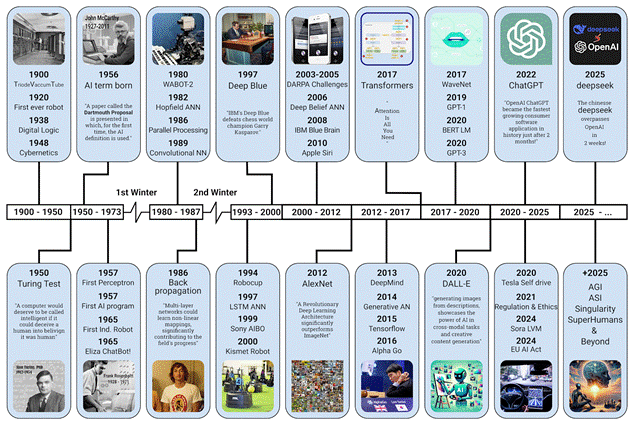
Timeline showing the evolution of artificial intelligence from symbolic logic to modern neural networks and machine learning from 1900 to beyond 2025.
Machine learning algorithms like support vector machines, decision trees, and early neural networks demonstrated superior performance in tasks such as pattern recognition, speech processing, and recommendation systems. Unlike symbolic AI, these systems could adapt and improve their performance as they processed more data, making them particularly suited for dynamic environments.[3][8]
Arthur Samuel’s checkers program from 1952 exemplified this approach, becoming the first computer program to learn and improve through self-play, showcasing the potential for machines to acquire complex skills through iterative learning.[3]
The Deep Learning Renaissance
The 2010s marked the beginning of the deep learning era, fundamentally reshaping the AI landscape. This renaissance was triggered by several converging factors: the availability of massive datasets, unprecedented computational power through GPUs, and sophisticated training algorithms.[5][9]
Key breakthroughs like AlexNet’s victory in the 2012 ImageNet competition demonstrated that deep neural networks could achieve human-level performance in image recognition tasks. This success sparked renewed investment and research in neural architectures, leading to rapid advances in computer vision, natural language processing, and game-playing AI.[9][6][5]
The introduction of transformer architectures in 2017 revolutionized how AI systems process sequential data, enabling breakthrough applications like GPT models and BERT for language understanding. These advances showed that neural networks could not only recognize patterns but also generate coherent text, translate languages, and engage in sophisticated reasoning tasks.[10][6]
Convergence: The Modern AI Synthesis
Today’s most advanced AI systems represent a convergence of these historically separate approaches. Neuro-symbolic AI combines the pattern recognition capabilities of neural networks with the logical reasoning strengths of symbolic systems, creating hybrid architectures that leverage the best of both worlds.[2][11][12]
Stylized human head diagram illustrating interconnected data flows and AI concepts relevant to symbolic logic and machine learning.
This convergence manifests in several ways. Large language models incorporate symbolic reasoning capabilities through structured prompting and logical frameworks. Hybrid systems use neural networks for perception and pattern recognition while employing symbolic reasoning for planning and decision-making.[2][12]
Companies like Google are developing next-generation architectures like Pathways, designed to train single models capable of thousands of different tasks, synthesizing the strengths of various AI approaches while addressing their individual weaknesses.[13]
Pathways to Future Intelligence
The evolution of AI continues to accelerate through multiple convergent pathways. Neuroevolution techniques combine evolutionary algorithms with neural network optimization, enabling the automatic discovery of optimal architectures. Brain-inspired computing approaches seek to replicate biological neural processes more faithfully, potentially leading to more efficient and adaptable AI systems.[12][14]
The integration of AI across multiple disciplines is fostering transformative applications in medicine, agriculture, physics, and economics. This multidisciplinary convergence is not merely expanding AI’s reach but fundamentally changing how we approach complex global challenges.[15]
The Unified Intelligence Vision
The trajectory from symbolic logic through machine learning to neural networks reveals a deeper pattern: the gradual convergence toward more general, adaptable, and powerful forms of artificial intelligence. Each approach contributed essential capabilities—symbolic AI provided interpretability and logical reasoning, machine learning enabled data-driven adaptation, and neural networks delivered powerful pattern recognition and generalization.
Modern AI systems increasingly integrate these approaches, creating architectures that can reason symbolically, learn from data, and recognize complex patterns simultaneously. This synthesis represents more than technological progress; it embodies our evolving understanding of intelligence itself.
As we advance toward more sophisticated AI systems, the convergence of these diverse approaches continues to shape new pathways for artificial intelligence development. The future promises even more integrated systems that combine the interpretability of symbolic reasoning, the adaptability of machine learning, and the powerful pattern recognition of neural networks into unified architectures capable of human-level reasoning across diverse domains.
The evolution of AI from separate computational paradigms to converged intelligent systems demonstrates how technological advancement often follows paths of integration and synthesis. Today’s AI revolution stands on the foundation laid by decades of research across symbolic logic, machine learning, and neural networks—each contributing essential elements to the sophisticated artificial intelligence systems that are transforming our world.
⁂
1. https://bernardmarr.com/the-evolution-of-ai-transforming-the-world-one-algorithm-at-a-time/
2. https://smythos.com/developers/agent-development/symbolic-ai-and-logic/
3. https://www.akkio.com/post/history-of-machine-learning
4. https://www.geeksforgeeks.org/artificial-intelligence/evolution-of-ai/
5. https://www.calmu.edu/news/future-of-artificial-intelligence
6. https://codewave.com/insights/development-of-neural-networks-history/
7. https://www.techtarget.com/whatis/feature/History-and-evolution-of-machine-learning-A-timeline
8. https://en.wikipedia.org/wiki/Timeline_of_machine_learning
9. https://sidecar.ai/blog/the-evolution-of-neural-networks-and-their-powerful-role-in-ai-technologies
10. https://www.linkedin.com/pulse/evolution-neural-networks-guide-ai-product-managers-shrivastava-bt13f
11. https://neurosymbolic-ai-journal.com/system/files/nai-paper-792.pdf
12. https://www.nature.com/articles/s41598-025-92190-7
13. https://blog.google/technology/ai/introducing-pathways-next-generation-ai-architecture/
14. https://en.wikipedia.org/wiki/Neuroevolution
15. https://pmc.ncbi.nlm.nih.gov/articles/PMC12380711/
16. https://en.wikipedia.org/wiki/Symbolic_artificial_intelligence
17. https://www.tableau.com/data-insights/ai/history
18. https://www.geeksforgeeks.org/artificial-intelligence/what-is-symbolic-ai/
19. https://www.dataversity.net/a-brief-history-of-machine-learning/
20. https://en.wikipedia.org/wiki/History_of_artificial_intelligence
21. https://arxiv.org/html/2402.00854v4
22. https://en.wikipedia.org/wiki/Machine_learning
23. https://www.ibm.com/think/topics/history-of-artificial-intelligence
24. https://www.larksuite.com/en_us/topics/ai-glossary/symbolic-ai
25. https://www.lightsondata.com/the-history-of-machine-learning/
26. https://www.coursera.org/articles/history-of-ai
27. https://www.clickworker.com/customer-blog/history-of-machine-learning/
29. https://onlinelibrary.wiley.com/doi/full/10.1002/job.2856
30. https://5ly.co/blog/ai-tech-stack/
31. https://edtechdev.stanford.edu/convergence-artificial-intelligence
32. https://www.coursera.org/resources/job-leveling-matrix-for-artificial-intelligence-career-pathways
33. https://www.meegle.com/en_us/topics/neural-networks/neural-network-evolution
35. https://roadmap.sh/ai-engineer
36. https://en.wikipedia.org/wiki/Neural_network_(machine_learning)
37. https://aiforgood.itu.int/the-power-of-ai-convergence-for-global-impact/
38. https://www.linkedin.com/pulse/ai-learning-pathways-modern-organization-paul-boudreau-6q6ac
39. https://arxiv.org/abs/2212.11279
40. https://www.sciencedirect.com/science/article/pii/S277250302400032X