The Journey Through AI’s Technological Landscape
Artificial intelligence represents one of the most transformative technological developments of our time, emerging from decades of scientific breakthroughs, setbacks, and remarkable innovations. This comprehensive exploration traces the evolution of AI technologies from their theoretical foundations to today’s sophisticated systems that shape our digital world.
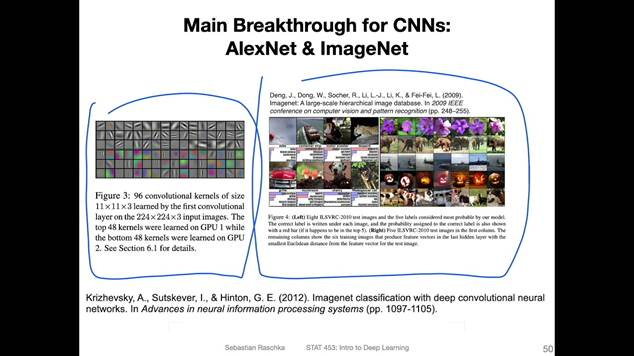
AlexNet’s convolutional kernels and ImageNet test images demonstrate the breakthrough in CNN-based AI for image recognition.
The Foundation Era: Birth of Machine Intelligence
The story of artificial intelligence begins in the 1950s when visionary scientists laid the groundwork for machine intelligence. Alan Turing’s seminal 1950 paper “Computing Machinery and Intelligence” introduced the famous Turing Test, establishing the first formal criterion for machine intelligence. This foundational work asked the profound question: “Can machines think?”[1][2][3]
The term “artificial intelligence” was officially coined at the 1956 Dartmouth Conference by John McCarthy, Marvin Minsky, Nathaniel Rochester, and Claude Shannon. This gathering of brilliant minds marked the formal birth of AI as a distinct field of study. During this era, researchers developed the first artificial neural networks, including the McCulloch-Pitts model in 1943 and Frank Rosenblatt’s Perceptron in 1958.[4][5][6]
These early neural networks, though primitive by today’s standards, established crucial concepts that would later become fundamental to modern AI systems. The Perceptron, capable of learning from data, represented the first practical demonstration of machine learning principles.[7][8]
The Challenging Winter Periods
AI development has been marked by cyclical patterns of enthusiasm and disappointment, known as “AI winters”. These periods of reduced funding and interest occurred when the technology failed to meet ambitious promises and expectations.[9][10]
The first major AI winter struck in the 1970s following the publication of the influential Lighthill Report in 1973. This British government-commissioned report criticized AI research for lacking practical applications, leading to significant funding cuts across the United Kingdom and influencing global AI research priorities.[11][10][9]
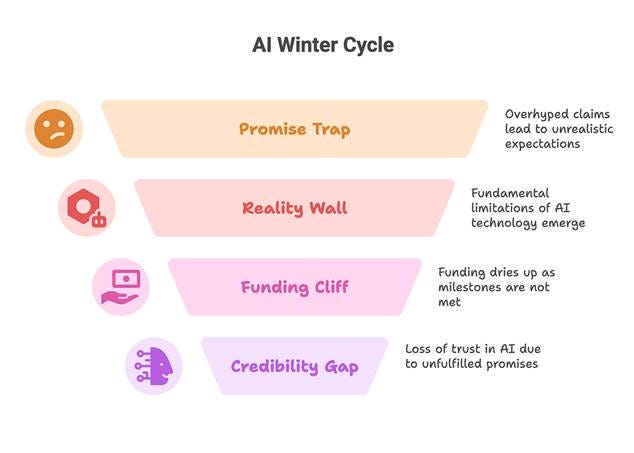
AI winter cycle stages showing causes of decline in artificial intelligence progress and funding.
The challenges during these winter periods included:
· Limited computational power insufficient for complex AI tasks[12]
· Unrealistic expectations about achieving artificial general intelligence[9]
· Fundamental limitations in expert systems and early neural networks[11]
· Economic factors and shifting government priorities[10]
The second AI winter occurred in the late 1980s and early 1990s when expert systems failed to handle unexpected inputs effectively. The collapse of LISP machine markets and the failure of Japan’s ambitious Fifth Generation computer project further contributed to this downturn.[12][10]
Despite these setbacks, AI winters ultimately led to more focused and grounded research approaches, laying the foundation for future breakthroughs.[9]
The Neural Network Renaissance
The resurgence of AI began with significant breakthroughs in neural network research. In 2006, Geoffrey Hinton demonstrated that deep belief networks could be efficiently trained using greedy layer-wise pre-training. This breakthrough marked the beginning of the modern deep learning era and initiated what many consider the third wave of neural network research.[13][14]
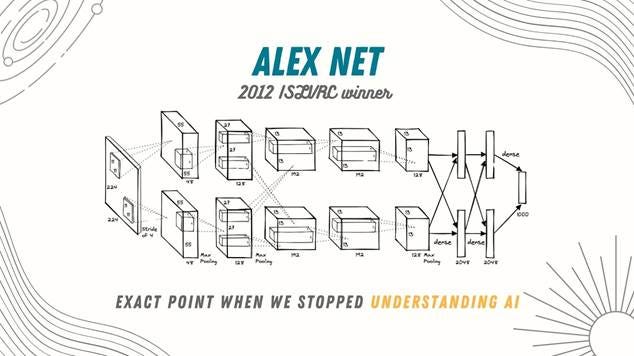
Diagram of AlexNet architecture, the 2012 ILSVRC-winning deep learning model that marked a breakthrough in AI understanding.
Hinton’s work, along with contributions from other pioneers like Yann LeCun and Yoshua Bengio, showed that neural networks with multiple hidden layers could learn complex representations of data. This discovery addressed fundamental limitations that had plagued earlier neural network approaches.[15][14]
The 2012 AlexNet breakthrough represents a pivotal moment in AI history. Alex Krizhevsky, working under Geoffrey Hinton’s supervision, developed a deep convolutional neural network that won the ImageNet Large Scale Visual Recognition Challenge by a dramatic margin. AlexNet’s success demonstrated the power of deep learning for computer vision tasks and sparked widespread adoption of neural network approaches across the AI community.[1][16][13][14]
The Transformer Revolution
The introduction of the Transformer architecture in 2017 through Google’s landmark paper “Attention Is All You Need” revolutionized natural language processing. This innovative architecture relied entirely on attention mechanisms, eliminating the need for recurrent or convolutional layers.[1][17][18]
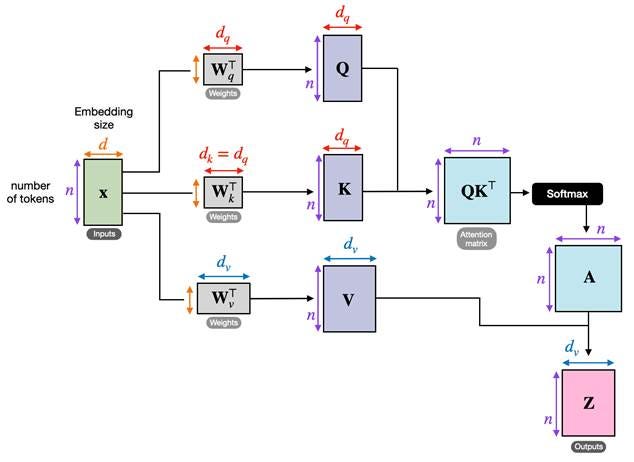
Diagram of the transformer architecture’s attention mechanism showing input embeddings transformed into query, key, and value matrices, followed by the computation of the attention matrix and output generation.
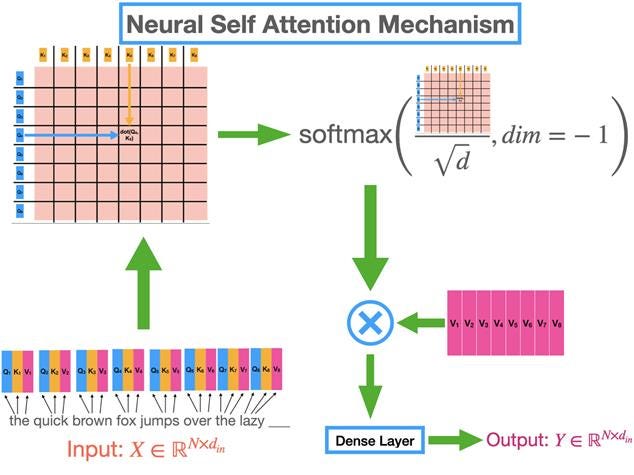
Diagram of the neural self attention mechanism used in transformer models for natural language processing.
The Transformer’s key innovations included:
· Self-attention mechanisms that allow models to focus on relevant parts of input sequences
· Parallel processing capabilities that significantly improved training efficiency[17][18]
· Superior handling of long-range dependencies in text and other sequential data[18]
This architecture became the foundation for large language models, including the GPT series developed by OpenAI. GPT-1, introduced in 2018, was the first to apply generative pre-training to the transformer architecture, setting the stage for the generative AI revolution that followed.[19][20]
The Generative AI Breakthrough
The release of ChatGPT in late 2022 marked a watershed moment in AI history, bringing sophisticated language models to mainstream audiences. Built on the GPT-3.5 architecture, ChatGPT demonstrated remarkable capabilities in natural language understanding and generation.[16][17][21]
The rapid evolution of generative AI includes several milestone developments:
GPT-2 (2019) showcased advanced text generation capabilities, initially raising concerns about potential misuse that led OpenAI to delay its full release. GPT-3 (2020) represented a massive scaling of language models with 175 billion parameters, enabling unprecedented natural language processing capabilities.[22][7][17][16]
GPT-4 and beyond have continued pushing the boundaries of what AI systems can accomplish, incorporating multimodal capabilities that process text, images, and audio. These advances have democratized access to powerful AI tools, enabling applications across countless domains.[17][19]
Current Technological Landscape
Today’s AI ecosystem encompasses diverse technologies that have evolved from decades of research and development. Modern neural networks now contain millions or billions of parameters and are trained on vast datasets, a dramatic evolution from the simple networks of the 1980s.[23]
Key contemporary AI technologies include:
Convolutional Neural Networks (CNNs) excel at image recognition and computer vision tasks, building on foundational work by Yann LeCun and others. Recurrent Neural Networks (RNNs) and their advanced variants like LSTMs handle sequential data processing.[5][24][6][14]
Transformer-based models dominate natural language processing applications, powering everything from search engines to content generation. Generative Adversarial Networks (GANs), introduced by Ian Goodfellow in 2014, enable AI systems to create remarkably realistic synthetic content.[1][22][18][20]
The integration of these technologies has produced AI systems capable of:
· Understanding and generating human language at near-human levels[17][21]
· Recognizing and analyzing visual content with superhuman accuracy[22][6]
· Making complex decisions in games like chess, Go, and video games[16][7][22]
· Automating creative tasks including art generation, music composition, and writing[22][17]
Looking Forward: The Continuing Evolution
The current state of artificial intelligence represents an unprecedented convergence of theoretical understanding, computational power, and practical applications. Unlike previous AI winters, today’s technology has demonstrated clear commercial value and practical utility across numerous industries.[2][16][12][25]
Modern AI development benefits from several factors that distinguish it from earlier eras:
Massive datasets enable training of increasingly sophisticated models. Advanced computational infrastructure, including specialized AI chips and cloud computing resources, provides the processing power needed for complex AI systems.[13][14][23]
Open-source frameworks and collaborative research environments have accelerated innovation and democratized AI development. Diverse applications across healthcare, finance, transportation, and other sectors demonstrate AI’s practical value beyond academic research.[22][6][18][13]
The field continues evolving rapidly, with ongoing research into more efficient architectures, better training methods, and novel applications. As we’ve learned from AI’s cyclical history, maintaining realistic expectations while pushing technological boundaries remains crucial for sustained progress.
The journey from simple perceptrons to sophisticated language models illustrates humanity’s remarkable progress in creating intelligent machines. Each breakthrough has built upon previous work, creating the rich technological landscape that defines modern artificial intelligence. This evolutionary process continues today, promising further innovations that will reshape our relationship with technology and expand the boundaries of what machines can accomplish.
⁂
1. https://www.aiprm.com/timeline-of-ai-technology/
2. https://wearetechwomen.com/the-evolution-of-artificial-intelligence-from-origins-to-2024/
4. https://codewave.com/insights/development-of-neural-networks-history/
5. https://www.techtarget.com/whatis/feature/History-and-evolution-of-machine-learning-A-timeline
6. https://www.ibm.com/think/topics/history-of-artificial-intelligence
7. https://www.theainavigator.com/ai-timeline
8. https://www.ibm.com/think/topics/neural-networks
9. https://www.cognitech.systems/blog/artificial-intelligence/entry/ai-winter-periods
10. https://en.wikipedia.org/wiki/AI_winter
11. https://aibc.world/learn-crypto-hub/ai-winter-history/
13.
14. https://pmc.ncbi.nlm.nih.gov/articles/PMC7861305/
15. https://en.wikipedia.org/wiki/Geoffrey_Hinton
16. https://www.weforum.org/stories/2024/10/history-of-ai-artificial-intelligence/
17. https://arxiv.org/html/2304.02017v12
19. https://en.wikipedia.org/wiki/Generative_pre-trained_transformer
20. https://en.wikipedia.org/wiki/Transformer_(deep_learning_architecture)
21. https://www.sciencedirect.com/science/article/pii/S266734522300024X
22. https://www.tableau.com/data-insights/ai/history
24. https://en.wikipedia.org/wiki/Neural_network_(machine_learning)
25. https://www.forbes.com/sites/paulocarvao/2025/08/24/are-we-heading-into-another-ai-winter/
26. https://www.linkedin.com/pulse/key-milestones-history-ai-19502024-md-morsaline-mredha-4oj8c
27. https://brightsg.com/blog/evolution-artificial-intelligence-journey-1950s-age-generative-ai/
28. https://en.wikipedia.org/wiki/History_of_artificial_intelligence
29. https://cs.stanford.edu/people/eroberts/courses/soco/projects/neural-networks/History/history1.html
30. https://ourworldindata.org/brief-history-of-ai
31. https://www.dataversity.net/a-brief-history-of-machine-learning/
32. https://en.wikipedia.org/wiki/History_of_artificial_neural_networks
33. https://www.coursera.org/articles/history-of-ai
34. https://en.wikipedia.org/wiki/Timeline_of_artificial_intelligence
35. https://www.tencentcloud.com/techpedia/100190
36. https://www.cs.toronto.edu/~hinton/absps/NatureDeepReview.pdf
37. https://www.ibm.com/think/topics/generative-ai
38. https://www.perplexity.ai/page/History-of-AI-A8daV1D9Qr2STQ6tgLEOtg
39. https://helixiora.com/genai-history-a-living-timeline-of-generative-ai-breakthroughs/