First Amendment: The Foundation of American Democracy
The First Amendment to the United States Constitution stands as the bedrock of American democratic principles, establishing fundamental rights that have shaped the nation’s identity for over 230 years. Adopted on December 15, 1791, as part of the Bill of Rights, this constitutional provision continues to evolve through modern legal interpretations and contemporary challenges.[1][2][3]
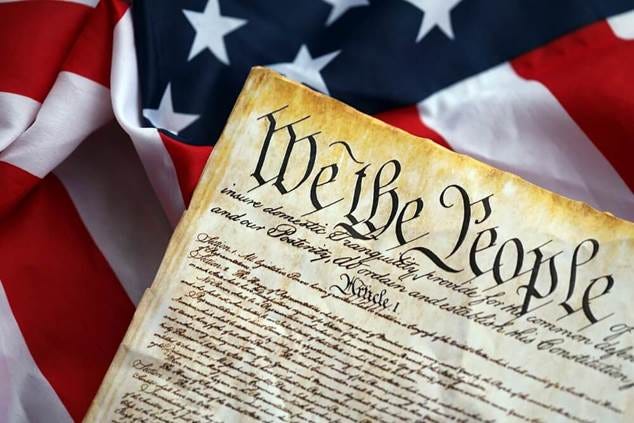
The United States Constitution with “We the People” and an American flag background symbolizes foundational American freedoms.
The Five Essential Freedoms
The First Amendment encompasses five critical liberties that work together to create a framework for democratic participation and individual expression.
Religious Liberty: Establishment and Free Exercise
The amendment opens with two complementary religious clauses. The Establishment Clause prevents government from endorsing or favoring any religion, maintaining the principle of separation between church and state. Meanwhile, the Free Exercise Clause protects individuals’ rights to practice their faith freely, though this right can be limited when religious practices conflict with compelling government interests.[1][2][4]
Recent Supreme Court cases have significantly impacted religious freedom interpretations. In Mahmoud v. Taylor (2025), the Court ruled that public schools violated parents’ free exercise rights by requiring elementary students to read books affirming gay marriage without providing opt-out options. The Court also strengthened religious tax exemptions in Catholic Charities Bureau Inc. v. Wisconsin (2025), protecting longstanding exemptions for religious nonprofits.[2][5][1]
Freedom of Speech: The Cornerstone of Democracy
Freedom of speech represents perhaps the most recognized aspect of the First Amendment, protecting the right to express ideas, opinions, and information without government content-based restrictions. However, this protection is not absolute. Categories of speech receiving limited or no protection include incitement to violence, defamation, obscenity, true threats, and fighting words.[1][6][7]
The 2024-2025 Supreme Court term brought significant developments in speech jurisprudence. In Free Speech Coalition, Inc. v. Paxton (2025), the Court upheld Texas’s age verification law for pornographic websites, applying intermediate scrutiny rather than strict scrutiny to content restrictions protecting minors.[2][3][7][1]
A wooden podium with three microphones ready for public speaking, symbolizing freedom of speech and expression.
Digital Age Challenges to Free Speech
Social media platforms have emerged as the new frontier for First Amendment interpretation. The Supreme Court addressed multiple social media cases in 2024, establishing that platforms have their own First Amendment rights when moderating content. In the NetChoice cases (Moody v. NetChoice and NetChoice v. Paxton), the Court determined that Texas and Florida laws restricting content moderation likely violated the First Amendment, though it remanded the cases for further analysis.[6][8][3][9]
These decisions clarified that internet users maintain First Amendment rights when posting on social media, but government interference with content moderation may infringe these rights, while independent platform decisions do not. The Court emphasized that social media platforms, like traditional publishers, have editorial discretion protected by the First Amendment.[8][9][6]
Freedom of the Press: Democracy’s Watchdog
Freedom of the press extends beyond individual speech to protect media organizations’ ability to report news and express opinions without government censorship. This protection serves as a crucial check on government power, enabling the press to function as democracy’s watchdog. Recent concerns have emerged regarding press access restrictions and funding cuts to public media under the current administration.[1][10]
Rights of Assembly and Petition
The First Amendment protects peaceful assembly and the right to petition government for redress of grievances. These rights enable collective action and formal channels for expressing dissatisfaction with government policies. Recent campus protests and demonstrations have tested the boundaries of these protections, particularly regarding student speech rights and university responses.[1][11][12]
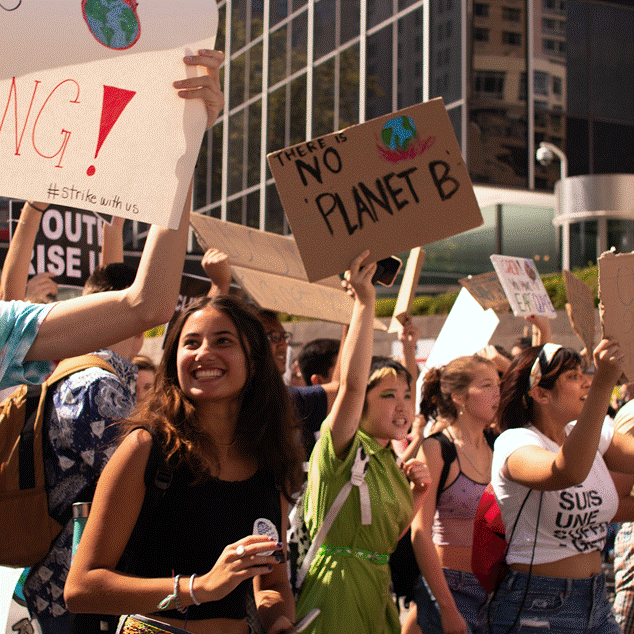
People participating in a peaceful protest holding signs that express their messages, illustrating freedom of speech and assembly rights.
Campus Free Speech: A Modern Battleground
Educational institutions represent a critical arena for First Amendment application. The Supreme Court established in Tinker v. Des Moines (1969) that students do not “shed their constitutional rights at the schoolhouse gate”. However, schools maintain broader authority to regulate speech than other government entities, particularly when speech substantially disrupts the educational environment.[13][14][15][16][17]
Recent legislative efforts have focused on protecting campus free speech. As of 2024, at least 23 states have adopted Campus Free Speech Protection laws. The U.S. House of Representatives passed the End Woke Higher Education Act in 2024, which includes provisions requiring colleges to disclose speech policies and prohibiting discrimination against student organizations based on viewpoint.[18][19]
Student speech rights vary by educational level. K-12 students enjoy constitutional protections but face greater restrictions than college students. Schools can prohibit speech that causes substantial disruption, violates others’ rights, or contains lewd, vulgar, or profane language.[14][15][16][17][13]
Contemporary Challenges and Debates
Immigration and Political Speech
A concerning development involves the targeting of immigrants for political speech. The case of Mahmoud Khalil, a Columbia University graduate and lawful permanent resident detained by ICE for pro-Palestinian advocacy, highlights tensions between national security concerns and First Amendment protections. The American Civil Liberties Union argues this represents viewpoint-based censorship that violates fundamental free speech principles.[20][11]
Religious Expression in Public Schools
The intersection of religious freedom and education continues evolving. Recent executive actions have established taskforces to review “anti-Christian bias” and relaxed enforcement of restrictions on political endorsements by tax-exempt religious organizations. Several states have passed laws requiring religious displays in public schools, though constitutional challenges remain pending.[21][4]
Technology and Free Speech
The digital revolution has created new First Amendment challenges requiring courts to balance traditional free speech principles with technological realities. Questions persist about how First Amendment principles apply to artificial intelligence, online harassment, and emerging communication platforms.[6][8][9][22][23]
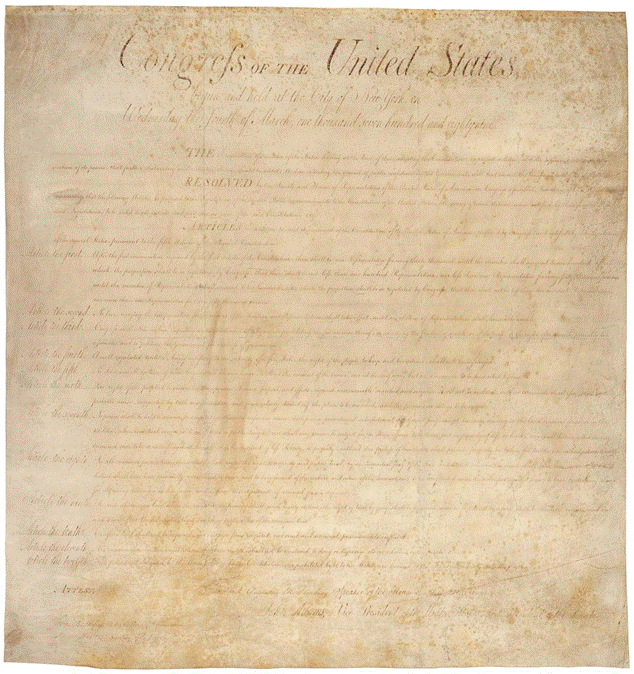
Historical document of the United States Bill of Rights, including the First Amendment, on aged parchment.
The Path Forward
The First Amendment remains a living document, continually interpreted through Supreme Court decisions that define the scope and limits of constitutional freedoms. Current debates reflect ongoing tensions between competing values: security versus liberty, religious freedom versus secular governance, and individual expression versus community standards.[1][2][3][12][21]
As American society continues evolving, the First Amendment’s principles must adapt to new challenges while preserving the fundamental freedoms that define democratic governance. The amendment’s endurance lies not in rigid interpretation but in its capacity to balance competing interests while protecting the essential rights that enable democratic participation and individual dignity.[12][21][1]
Understanding these five freedoms and their contemporary applications remains crucial for citizens participating in American democracy. Whether exercised through voting, protesting, worship, or public discourse, First Amendment rights require both protection and responsible exercise to maintain the delicate balance between freedom and order that characterizes constitutional democracy.
⁂
3. https://supreme.justia.com/cases-by-topic/free-speech/
4. https://www.whitehouse.gov/presidential-actions/2025/02/eradicating-anti-christian-bias/
5. https://firstliberty.org/news/the-supreme-courts-next-term-will-be-monumental-for-religious-freedom/
7. https://www.supremecourt.gov/opinions/24pdf/23-1122_3e04.pdf
9. https://www.thefire.org/news/8-first-amendment-cases-supreme-court-will-decide-term
10. https://opentodebate.org/debate/free-speech-in-the-trump-2-0-era/
11. https://www.aclu.org/news/free-speech/free-speech-under-fire-in-americas-schools
12. https://globalpeace.org/free-speech-enduring-myriad-threats-challenges-in-2025/
14. https://en.wikipedia.org/wiki/Freedom_of_speech_in_schools_in_the_United_States
16. https://ncac.org/resource/first-amendment-in-schools
17. https://www.nyclu.org/resources/know-your-rights/free-speech-in-public-schools
18. https://alec.org/article/u-s-house-of-representatives-passes-campus-free-speech-legislation/
19. https://firstamendment.mtsu.edu/article/campus-free-speech-protection-laws/
20. https://verfassungsblog.de/free-speech-khalil-palestine-us/
21. https://www.acslaw.org/analysis/acs-program-guides/the-first-amendment-in-flux/
22. https://firstamendment.mtsu.edu/article/social-media/
24. https://firstamendment.mtsu.edu/cases-by-date/
25. https://www.thefire.org/news/you-cant-fire-your-way-free-speech
26. https://www.oyez.org/cases
29. https://www.ft.com/content/336c171c-f49e-41e5-81c1-9018a6949d2c
30. https://www.thefire.org/supreme-court
33. https://www.thefire.org/research-learn/frequently-asked-questions-campus-free-expression-cafe-act
34. https://www.bbc.com/news/articles/cyv43p1z15eo
35. https://www.aclund.org/news/first-amendment-was-upheld-2025-session-debate-continues/
36. https://www.thefire.org/research-learn/free-speech-high-school
37. https://www.congress.gov/bill/117th-congress/house-bill/4007
38. https://www.scotusblog.com/2025/07/is-religious-freedom-possible-in-state-schools/